

They say age is just a number. Most days I agree.
Ask me what it’s like to be my age on a good day, and I’ll tell you I wouldn’t want it any other way. I like who I am, where I am, and how I got here. I appreciate the peace of mind that comes with the confidence of experience. I love the feeling of being less bothered by peoples’ perceptions. And I enjoy yelling “get off my lawn” from my front porch. Figuratively and literally.
But catch me on a day when I’m fully feeling the weight of years gone by and I’ll be more than happy to share a more disgruntled point-of-view. I might try to get a laugh by imitating the cracking sound my knee makes every time I stand up, or joke about the struggle of putting on my socks in the morning. If I’m feeling especially grumpy I’ll tell you a story or two about the frustrations of working with younger generations. Dang millennials!
But mostly I’ll shout from the rooftops that ageism is real and job seekers better be ready for it.
Ageism is a Thing. The Stats Say So.
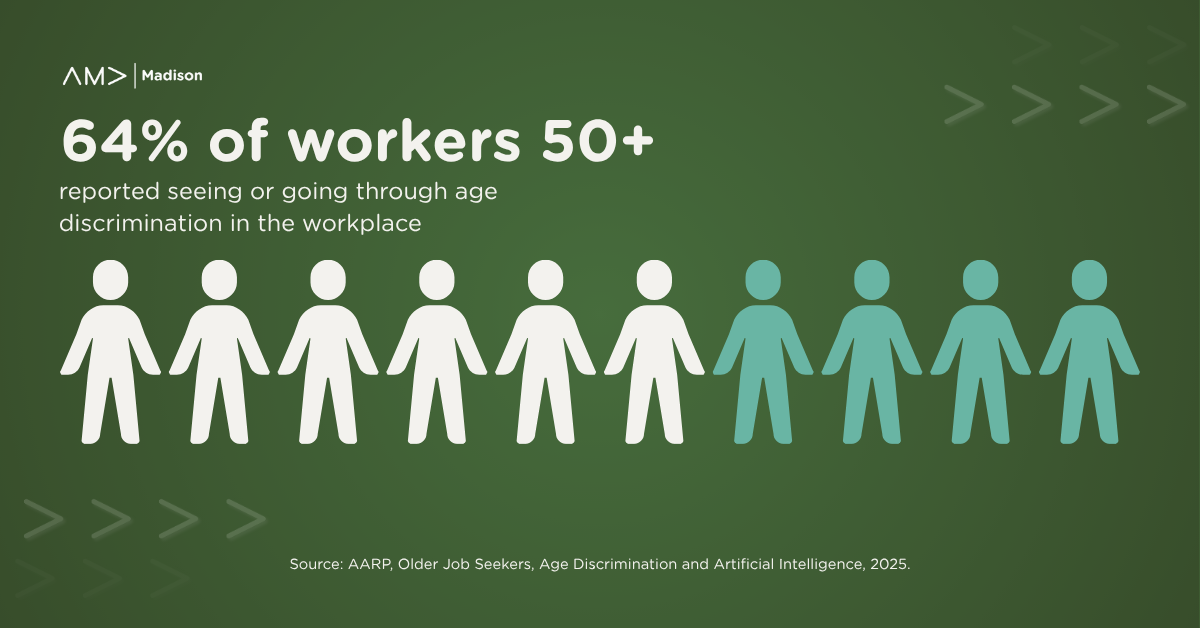
I’m not imagining things. In a 2025 AARP study, 37-percent of those aged 50-plus experienced age discrimination in job searches. And it doesn’t stop there. About two-thirds (64%) of workers 50-plus reported seeing or going through age discrimination in the workplace and 22% feel like they’re being pushed out of their job because of their age.
The Age Discrimination in Employment Act (ADEA) forbids age discrimination against people age 40 or older. But the law doesn’t stop it from happening. Why? Because ageism is mostly built on unfounded stereotypes. Employers often assume older workers have lower energy, lack tech skills, or expect high salaries. Add in the fact that today’s AI-driven applicant tracking systems filter out resumes before a human ever sees them, and you get a recipe for rejection.
If you’re over 40, or 50, or heck, 100 (because again, age is just a number, right?) here’s what you can do to make sure employers look at you for you, not how long you’ve been you.
Use your network: It took you time to build it over the years, you might as well use it. Tap into your relationships and the connections you’ve made. Think about all the great people you’ve met at career stops along the way. If you didn’t burn all your bridges, there’s bound to be a former colleague who might know somebody who knows somebody.
Target specific employers: LinkedIn, Indeed, Monster… sure, they sound like they should be great ways to reach a big pile of potential employers from anywhere in the world. But that’s what everybody else is thinking too. To stand out from the crowd, home in on companies you know a little bit about. That way you can make sure the culture, mission and brand are good fits with where you are at this point in your life.
Shift perceptions: By demonstrating enthusiasm and versatility, highlighting the problem-solving skills sharpened through experience, and framing your background around current business challenges, you’re letting potential employers know where they can shove their stereotypes. In a nice way, of course.
Refresh Your Resume: Should the number of years since you’ve graduated college matter? No. But to some hiring minds, it does. It’s not fair, but it’s reality. By restricting your resume to the last 10 to 15 years of experience, removing graduation dates, and dropping old-school talk like “references available upon request,” you’re controlling the conversation and keeping all eyes on what you bring to the table.
Outsmart Biased Screening: In my recent search, I started to wonder if any of the jobs I applied to through the big-brand sites were even real. I’d send my constantly reworked resume and wonderfully worded cover letter, only to get a rejection the next day. “Your background is impressive, but…” I blame AI. A recent Stanford University study found that over 90% of companies use automated screening, meaning you might be discarded before a hiring human even knows you exist. So, be careful where you share your list of impressive skills in an online form. The best way to get in front of a potential employer might just be the way we used to do it — a good old-school direct email or networking face-to-face.
Being Yourself Still Matters
Would I do it all over again? Heck no! I do not envy Millennials, Gen Z, or Gen Alpha… or whatever label the marketing world slaps on people nowadays. It’s tough out there and getting tougher. The one big thing I learned in this last job search: Be who I am and be proud of how I got here. That still matters to a lot of good companies. I can confidently say that approach worked for me. I start my new job next week. The one my network helped me find. Take that, stereotypers.
Now get off my lawn!

via SpongeBob SquarePants on GIPHY
About the Author

Jason Schultz
Jason M. Schultz, is a creative copywriter, a strategic storyteller and a builder of brands. Learn more about his award-winning work at smartmouthcopy.com.
Connect on LinkedIn